
At some point this year, someone sold their best performing stock.
They had a gain. A real one. They felt smart. They moved on. Then they watched it keep going.
Maybe it was yours.
This is not a story about one stock. It’s the most common and most expensive mistake in investing. And almost nobody talks about it honestly because doing so requires admitting how often we get in our own way.
Here is the question I never hear anyone ask before they sell.
Where does that money go?
If you sell, you have to do something with the proceeds. You have to find something better. Something that will outperform what you just walked away from. And now you have to be right twice. Once on the sell. Once on the buy. Most people only think about the first part.
There is always a reason to sell
As I write this today, there are plenty of reasons to be nervous. There always are. Next week there will be different ones. The week after that, more still.
There has never been a moment in market history where the headlines were clean and the path forward was obvious. Go back to 1928 and work your way forward. Every single year had something scary. Wars. Recessions. Political chaos. Rate hikes. Pandemics. Every single year someone had a compelling reason to get out.
None of it mattered over the long term if you just stayed invested.
The market is sitting near all-time highs right now. That makes a lot of people nervous. It feels like the wrong time to hold. But consider this.
After an all-time high, the S&P 500 made another all-time high 93% of the time within the next month. 99% of the time within the next year. All-time highs are not warnings. They are what healthy markets do.
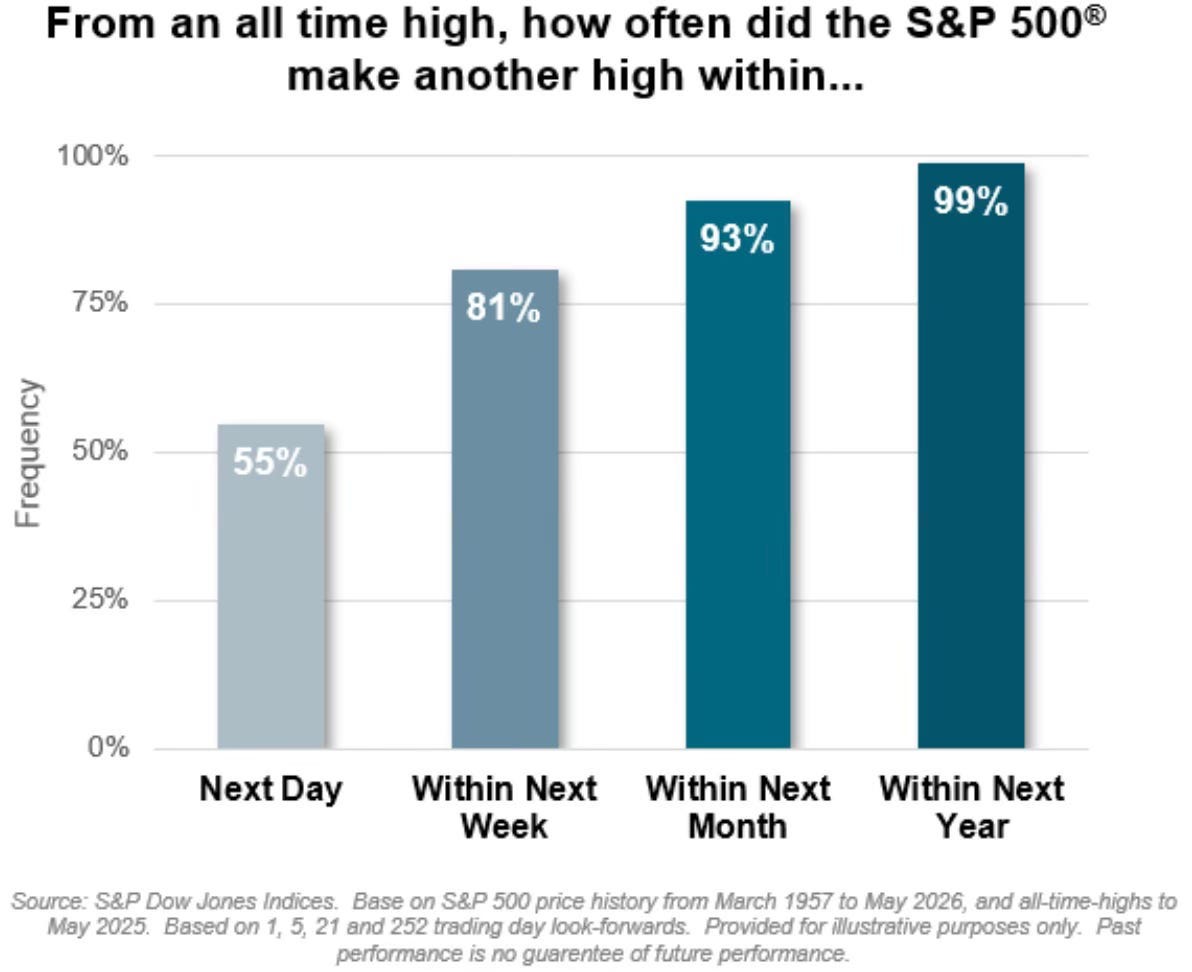
Selling because the market is at a high is not a strategy. It’s fear dressed up as logic.
There is a difference between investing and trading
This matters and most people blur the line.
Trading is short-term. It is reactive. It responds to price movements, news cycles, and what someone on TV said this morning. There is nothing wrong with trading if that is what you are doing intentionally.
Investing is different. Investing means you own a piece of a business. You bought it because you believe in where that business is going over years, not weeks. The daily price movement is noise. The quarterly earnings call is signal.
When you sell a great business because the stock is up, you are trading. You are letting the price tell you what to do instead of the business.
Index funds never do this. The S&P 500 does not panic. It does not lock in gains. It does not second guess itself at all-time highs. It just owns great businesses and gets out of the way. That is a big part of why it is so hard to beat.
I learned this the hard way
In 2008 during the GFC, I bought Microsoft. It doubled. I sold every share. I had read that when a stock doubles you lock in your gains and move on. It felt like the right thing to do.
It was one of the worst investing decisions I ever made.
I was 23 years old and still learning. But the lesson cost me more than money. It cost me years of compounding I will never get back.
The next time I did it differently
When I bought Apple in 2014 I remembered that Microsoft mistake. Apple doubled. I held. It doubled again. I still own it today.
When I bought Nvidia in January 2022, after it had been cut in half, I applied the same lesson. It has since made a historic run. I have not sold a single share.
None of that was easy. Every one of those positions had moments where selling felt like the rational move. The market was down. The headlines were bad. The drawdowns they experienced were very real. Someone had a very convincing reason to get out.
But I kept coming back to the same question. If I sell, then what? What am I buying instead? Am I genuinely confident that new position outperforms what I just walked away from?
Most of the time I could not answer that. And that told me everything.
Are you scared to sell, or scared to hold?
Here is something worth sitting with. Sometimes selling is the right call. I am not saying hold everything forever regardless of what changes.
But there is a difference between selling because something has genuinely changed and selling because you are uncomfortable. One is discipline. The other is emotion with a rational sounding explanation attached to it.
Ask yourself this before you sell anything. Has the reason I bought this stock changed? Is the business worse than it was? Or am I just nervous because the price moved or because a headline scared me?
If nothing has changed in the business, you are probably about to make a mistake.
Your time horizon matters more than almost anything else here. My time horizon for this money is different from yours. Different from my parents. There is no universal right answer. But the question you should be asking is not “should I sell because it is up?” It is “does this still belong in my portfolio given why I bought it and how long I plan to hold it?”
So when would I actually sell? Not because of a price target. Not because of a percentage gain. Only a handful of things would make me pull the trigger. The story changes. Management does something that breaks my trust. The original reason I bought it no longer exists. Or something else earns that spot in my portfolio with higher conviction.
That is the whole framework. If none of those conditions are met, sitting on your hands is usually the right move.
Want to see exactly what I own and how I am applying this framework right now? Every Saturday morning I publish my Investing Update for paid subscribers, including a full breakdown of my current portfolio, what I am watching, and what I am thinking. Join them here.
Thank you for reading! If you enjoyed Spilled Coffee, please subscribe.
Spilled Coffee grows through word of mouth. Please consider sharing this post with someone who might appreciate it.