
Leave it to a steep selloff to bring out the questions. And the worries.
Since Friday’s selloff and my Saturday Investing Update, I’ve gotten more questions and worries than ever before from the roughly 8,000 of you who read Spilled Coffee. A lot of you aren’t sure exactly what’s happening. Or why it’s happening so fast.
So I felt it was important to really dig into what’s going on, and why this selloff has been so steep and so quick.
Most of your questions come down to one word. Why?
Why are stocks falling when the earnings are this good? And the one I hear the most. Isn’t this just the AI bubble finally popping?
I get it. That’s the easy answer. It’s all over social media. And plenty of people have been waiting a long time to say it.
But I don’t think that’s what’s happening. At least not the way most people mean it. The AI demand is real. The earnings are real. Something else is going on, and once you see it, this selloff makes a lot more sense.
Let me walk you through it.
What just happened
First, a quick look at just how bad it’s been.
On November 5, the S&P 500 fell 4.4%. Its worst day since the April 2025 tariff panic. The Nasdaq dropped 5.5% and slid into correction territory. The market tried to recover, but then came a series of new worries. Nvidia announced Jensen Huang’s resignation as CEO on November 12, disclosed it in an SEC filing, and named CFO Colette Kress interim CEO. Then new chip export restrictions landed on November 16, and the selling kept going.
Then Friday happened.
On November 20 the S&P 500 fell 3.7% to 6,910. Its seventh straight loss. The longest losing streak since February 2020. It closed 11.6% below its October 6 record, which puts it officially in a correction. Worst week since April 2025, down 8.6%.
The Nasdaq dropped 5.3%, wiping out its 2026 gain and turning negative for the year. Nvidia fell 14% in a single day. The VIX, Wall Street’s fear gauge, closed at 35.89, its highest in 19 months.
Here’s how fast that happened. The Nasdaq hit a record on October 6. Six weeks later it was negative for the year.
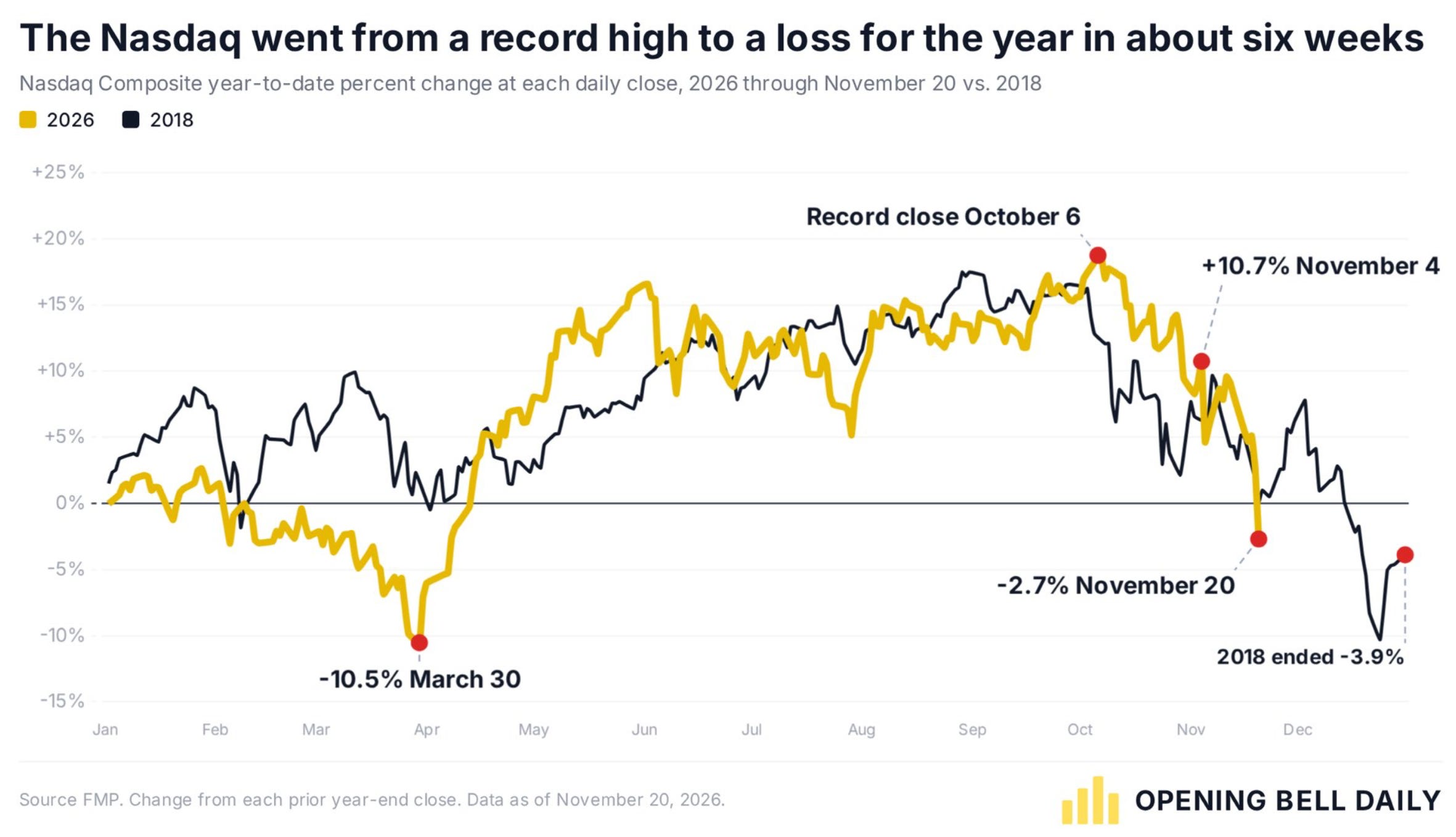
The dark line is 2018, another year the Nasdaq gave back its gains in the fall. That selloff was driven by Fed rate hikes. I’m showing it for the speed of the drop, not as a forecast.
I’m writing this Sunday evening. Futures are pointing up, which is a good start. But one green open doesn’t mean much. I want to see the market hold through Monday’s full session. If the bounce fades, or worse, we finish red, we have a problem.
Now look at what got hit hardest. Chipmakers. Data center names. The hyperscalers buying the chips, meaning the giant cloud companies like Microsoft, Amazon, Google, and Meta. Everything tied to AI got hit.
But the data centers are still getting built. Nvidia just beat and raised. Demand isn’t the problem.
The problem is money. Who’s paying for all of this, and how.
So here’s the real reason stocks are selling off. Not because AI stopped working. Because the bill for building it keeps getting bigger, and it’s getting harder to pay.
The short version
The biggest tech companies are now spending nearly every dollar of operating cash flow on AI infrastructure.
So they’re borrowing and selling stock to cover the rest.
Borrowing just got more expensive, with rates near 5%.
And a huge share of the stock market’s future profit growth depends on that spending continuing.
When the cost of financing future profits goes up, investors are willing to pay less for those profits today. That’s the selloff in one sentence.
One honest caveat before we go further. Money isn’t the only thing going on. Three forces are hitting at once, and they feed each other.
AI financing. The cost of paying for the buildout is going up. That’s the focus of this piece.
Rates. The 10-year is near 5%. As of Friday, futures priced about a 95% chance of a December Fed hike. That’s the market’s bet, not a signal from the Fed itself. That pressures valuations and makes every dollar of borrowing cost more.
Positioning. The stocks that drove this year’s gains were crowded, meaning lots of big investors owned the same names. Now they’re all selling at once. Goldman says the selloff has expanded from an AI unwind to a broader growth downgrade.
Nvidia also has its own problems on top of all this. A new CEO search, a reported SEC probe into its disclosures, and questions from Washington about chip sales to China. Not all of its drop is about financing.
But the financing story is the one I think most investors are missing. So that’s where we’ll spend our time.
Think of it like building a house
Let me put this in terms that have nothing to do with chips or data centers.
Say you’re building a rental property. You know the demand is there. You’ve got a waiting list of people ready to rent it. That part’s not the question.
But here’s how building actually works. You pay the contractors, the lumber yard, the electrician long before you collect a single month of rent. The money goes out first. The income comes later.
At first you pay out of savings. Then the savings run low, so you cut back on everything else. Then you take out a construction loan. Maybe you bring in a partner and give up a piece of the property.
Now imagine two things happen in the middle of the build. Interest rates jump, so the loan suddenly costs a lot more. And the job runs late. The power company can’t hook you up for six months. You’re still paying the loan and the crew, but no rent is coming in.
The house is still worth building. The renters are still waiting. But your math just got a lot worse.
That’s what’s happening to Big Tech right now. The demand for AI is the waiting list. Their spending is the construction bill. Rates and delays are what’s squeezing them in the middle. And investors are doing what any lender would do. Asking how much this is really going to cost before it pays off.
Real renters mean it’s not a fantasy. But they don’t guarantee a good investment either. It’s a money problem if the build costs more and takes longer than planned.
Keep that house in mind. Everything that follows is a piece of it.
Why AI moves the whole market
Start with one number from Goldman Sachs.
Nvidia alone is expected to contribute nearly 25% of S&P 500 earnings growth next year.
One company. A quarter of the growth for the entire index.
I’ve seen this stat mangled a lot on social media. So let’s be clear about what it means. Nvidia is not 25% of S&P 500 earnings. By my rough math it’s closer to 10%, about in line with its weight in the index. And it’s nowhere near 25% of GDP. Its revenue runs under 2% of the US economy.
It’s 25% of the growth. That’s the part that matters.
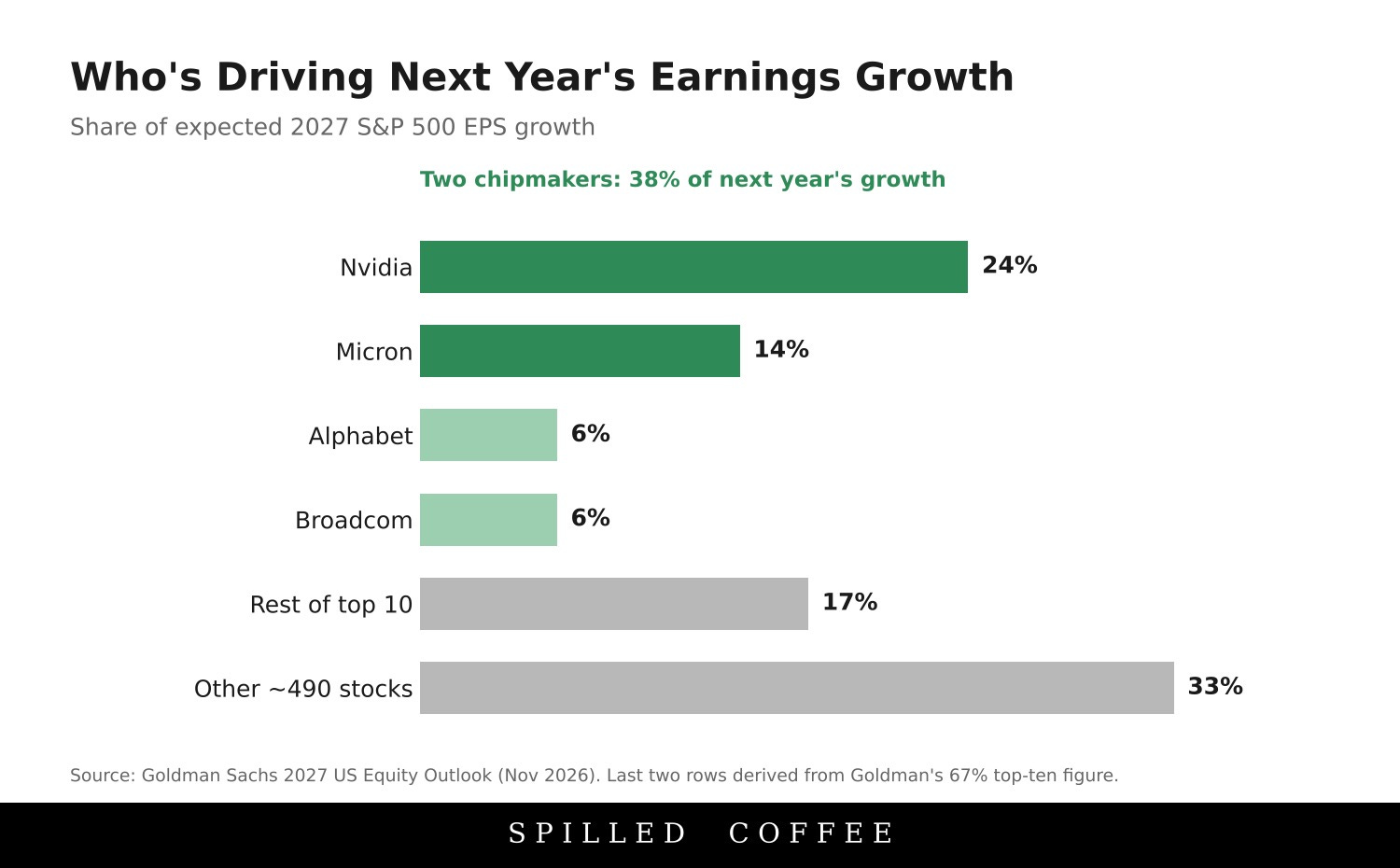
Nvidia’s profits are growing so fast that it carries a huge share of the index’s increase. Goldman’s 2027 outlook puts Nvidia at 24% and Micron at 14%. That’s 38% of next year’s growth from two chipmakers. The top ten contributors together drive two-thirds.
Goldman flagged something in the same report that I think matters even more. S&P 500 earnings are running roughly 25% above their long-term trend. Most of that comes from soaring semiconductor profit margins. Goldman’s view is that this level of profitability may be hard to sustain. And it thinks the boost to earnings from AI spending is nearing its peak.
That’s not a bear call. Goldman still expects solid earnings growth next year. About 11% on a headline basis, or 18% if you strip out one-time items like mega-cap tech’s investment gains. But it’s a reminder of how much of the market’s profit story runs through one industry’s margins.
So here’s the chain. The market’s earnings growth leans on Nvidia. Nvidia’s growth leans on a handful of customers spending more every single year.
If you own an S&P 500 index fund, you own this bet whether you meant to or not. When investors get nervous about Nvidia’s customers, they’re really getting nervous about the growth of the whole index. That’s why a selloff that starts in AI doesn’t stay in AI.
Which raises the obvious question. Can they keep paying for it? Before we get there, one more layer.
The economy is leaning on it too
It's not just the stock market. You’ve probably seen a stat on social media saying AI drove 65% of US GDP growth. That number comes from Torsten Sløk, chief economist at Apollo. In a November 19 note titled AI Spending Powers 65% of GDP Growth, he estimated AI investment added about 1.3 percentage points to growth over the last three quarters, out of roughly 2% total. That’s a lot of the economy riding on one spending cycle.
The spending outran the cash
For years, Big Tech paid for everything out of pocket. Huge cash flows. Massive buybacks. No need to borrow.
That era is ending. This is the savings running low.
Goldman estimates hyperscaler capex, their spending on data centers, chips, and power, will equal roughly 100% of their operating cash flow this year. PIMCO puts it at 94%. Two years ago it was under 50%. Nearly every dollar coming in is going right back out.
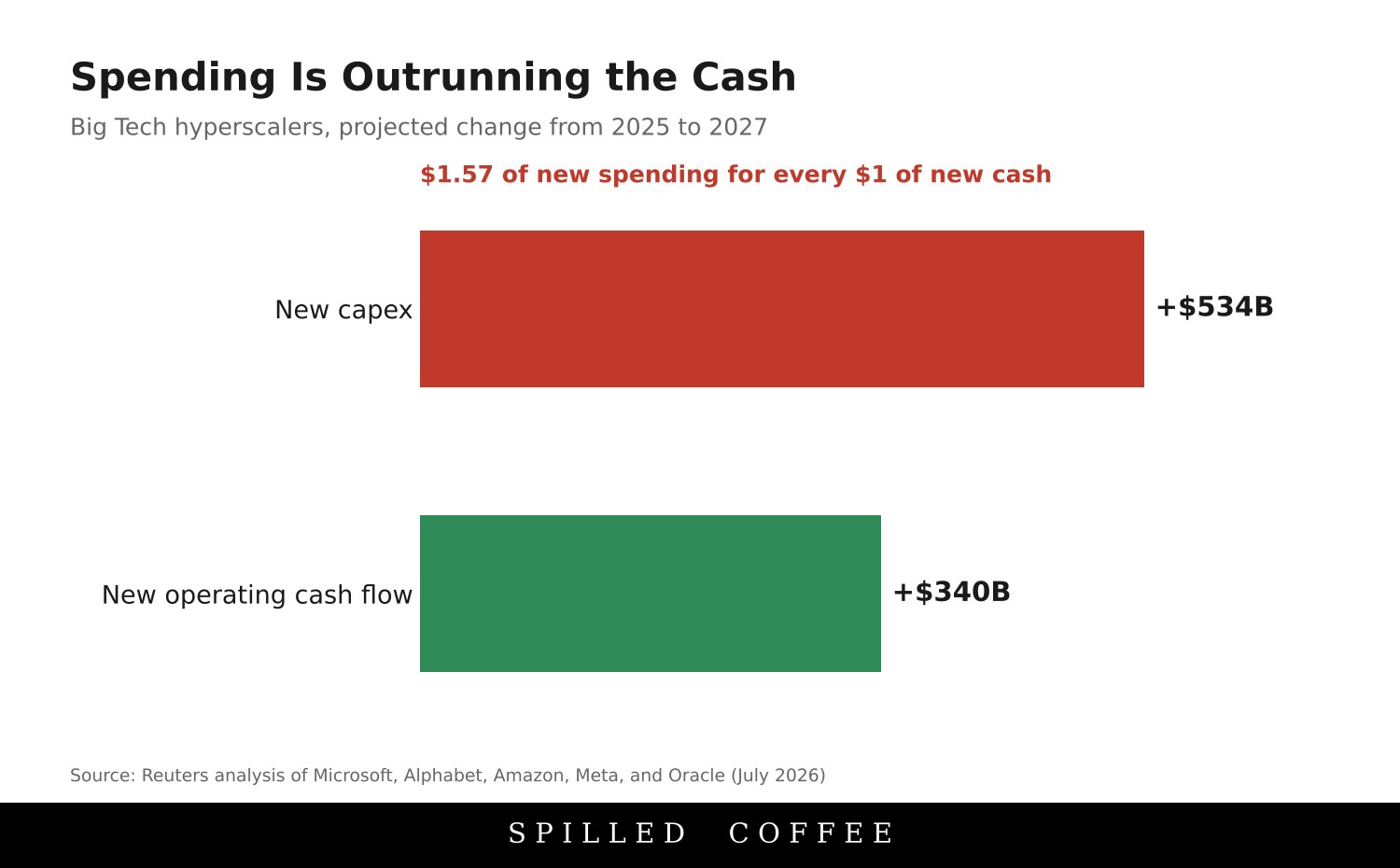
And it gets tighter from here. Reuters projects these companies will bring in about $340 billion more in operating cash flow in 2027 than in 2025. Capex is expected to rise about $534 billion over the same stretch. That’s $1.57 of new spending for every $1 of new cash.
You can already see it. Alphabet’s free cash flow, the cash left over after all that spending, turned negative this summer for the first time in its 22 years as a public company. Alphabet isn’t running out of money, but the direction is clear. And buybacks across the five hyperscalers fell 64% in the first quarter.
This is why I keep saying free cash flow matters more than earnings right now. When a company spends $50 billion on a data center, the cash leaves today. The expense shows up slowly through depreciation over five or six years. So earnings can look great while the cash is getting squeezed.
In the end, investors pay for cash, not accounting profits. When the cash shrinks, they’ll pay less for the same earnings, even when those earnings look great.
Enter the borrowing
When the cash runs out, you borrow. This is the construction loan. And they are borrowing a lot.
Goldman’s credit team counted $296 billion of hyperscaler debt so far this year, well above its $250 billion full-year forecast. It expects $440 billion in 2027. Even Microsoft sold $25 billion of bonds on October 29, its first US bond sale since 2017.
Then there’s circular financing. Think of it as the builder lending money to the buyer so the buyer can pay the builder. The IMF counted fourteen of these deals since 2023, with about $650 billion of debt and $1.4 trillion of future revenue commitments. Its warning: if AI profits disappoint, the damage travels through all of these linked deals.
Elon Musk put it bluntly. Lenders have nearly stopped funding AI data center companies without real revenue outside the AI buildout. And he flagged a bigger problem: “Even cumulative industry delays of a few months between paying for compute and getting it reliable enough to generate revenue will mean hundreds of billions of incremental dollars just for working capital. Where will that come from?”
This is the power company that can’t hook you up for six months. So I ran the math. He’s right.
The big five are expected to spend about $690 billion on capex this year and $870 billion next year. That’s roughly $58 billion to $73 billion a month going into capacity that isn’t earning anything yet.
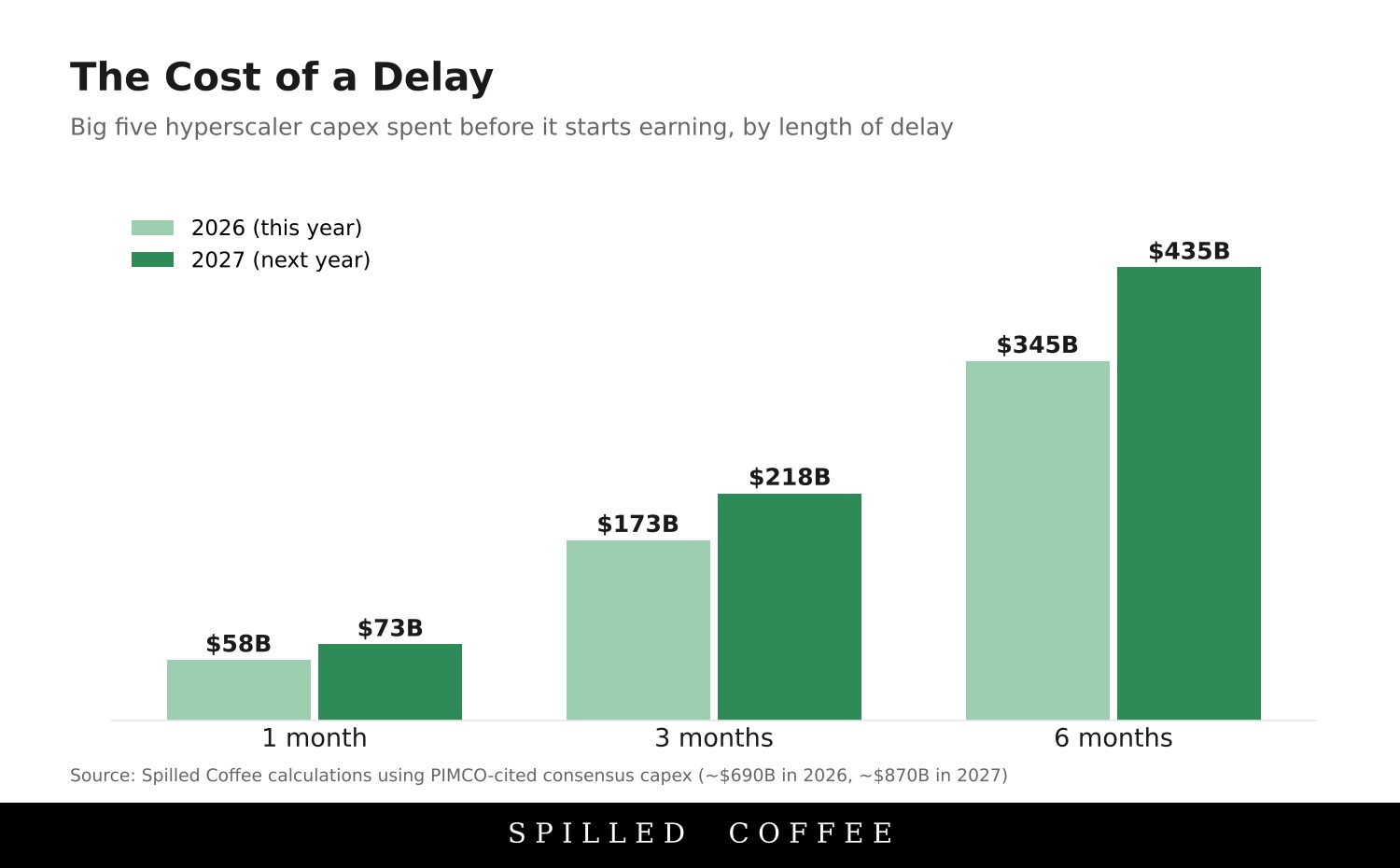
It’s rough math, but a three-month slip next year is over $200 billion. Six months is about the same as the $440 billion Goldman expects them to borrow in all of 2027. And that’s just the five biggest companies. You can’t fix it with money, either. Power, cooling, and getting thousands of chips to run reliably are physical problems.
Borrowed money has to be paid back with interest. The more it costs to borrow, the less each dollar of future AI profit is worth today. That’s a big reason these stocks fell even on good news.
The debt you can’t see
The bond deals get the headlines. The bigger story might be what’s not on the balance sheet.