
Everyone tells you to diversify.
Your advisor. Your 401(k) brochure. Every finance show on TV. Own a little of everything. Spread it out. Don’t put all your eggs in one basket.
It’s the closest thing investing has to a commandment.
I think it’s mostly wrong. Or at least wildly oversold.
Diversification isn’t useless. But somewhere along the way diversify stopped meaning don’t blow yourself up and started meaning own 30 stocks and hope. That’s not a strategy. That’s a hedge against having one.
Winners Are Rare
Here’s the part nobody puts in the brochure.
Hendrik Bessembinder is a finance professor at Arizona State. This year he finished a study of every U.S. stock from 1926 through 2025. All 29,754 of them.
The median stock’s total lifetime return was negative 6.9%. Nearly 60% did worse than Treasury bills over their lifetimes. And all of the market’s net wealth creation came from just 3.7% of companies.
Here’s what that looks like.
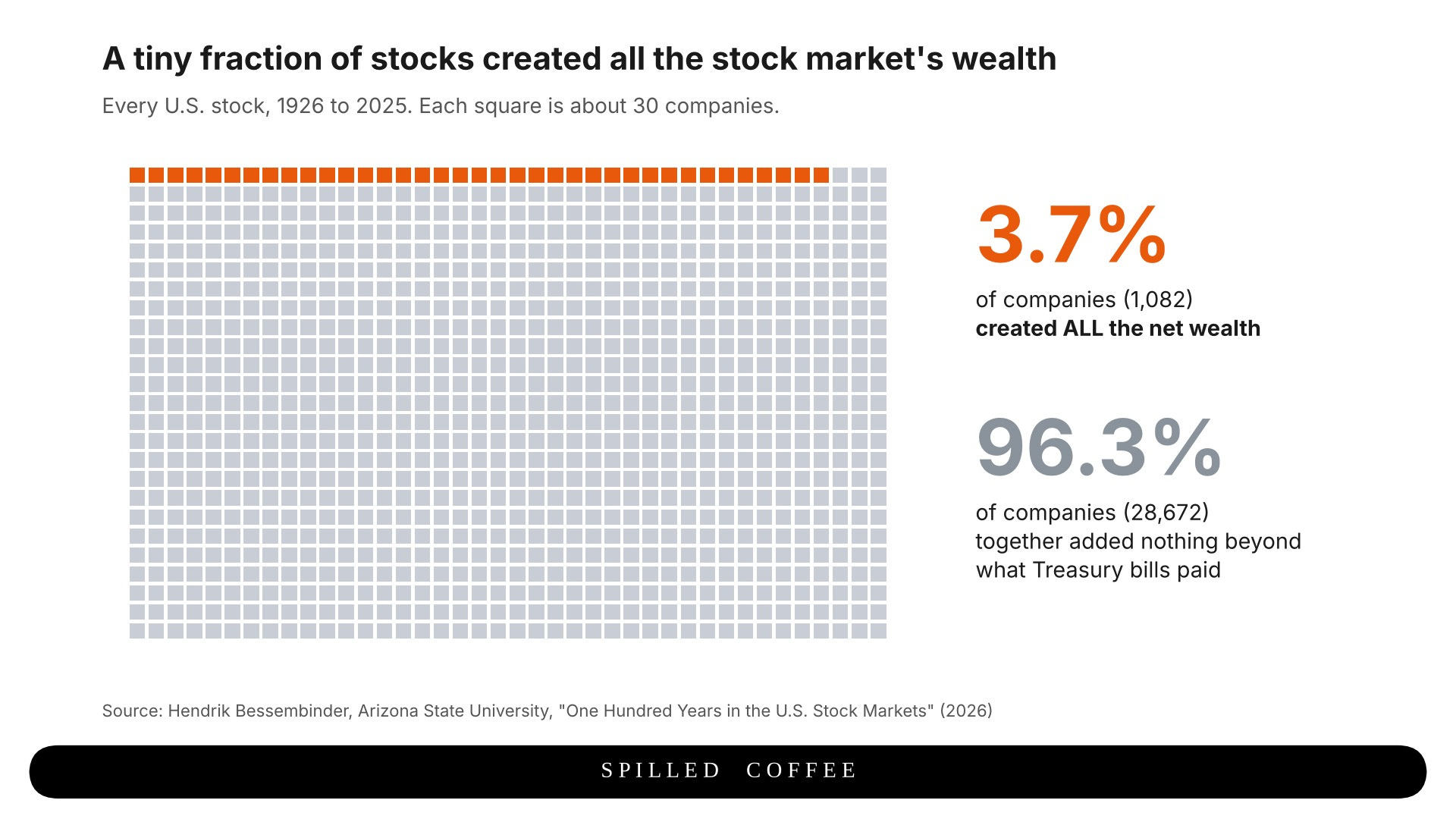
Think about that. Just 3.7% of companies created all the wealth the U.S. stock market generated beyond what Treasury bills paid. In a century.
And it’s getting more concentrated. In his 2018 study, 89 companies accounted for half of all the wealth created. Now it’s just 46. Apple and Nvidia alone account for about 10% of a century of stock market wealth.
It’s not just history, either. It’s happening right now. Only about 30% of S&P 500 stocks have beaten the index over the last three years. That’s near the lowest reading since 1991.
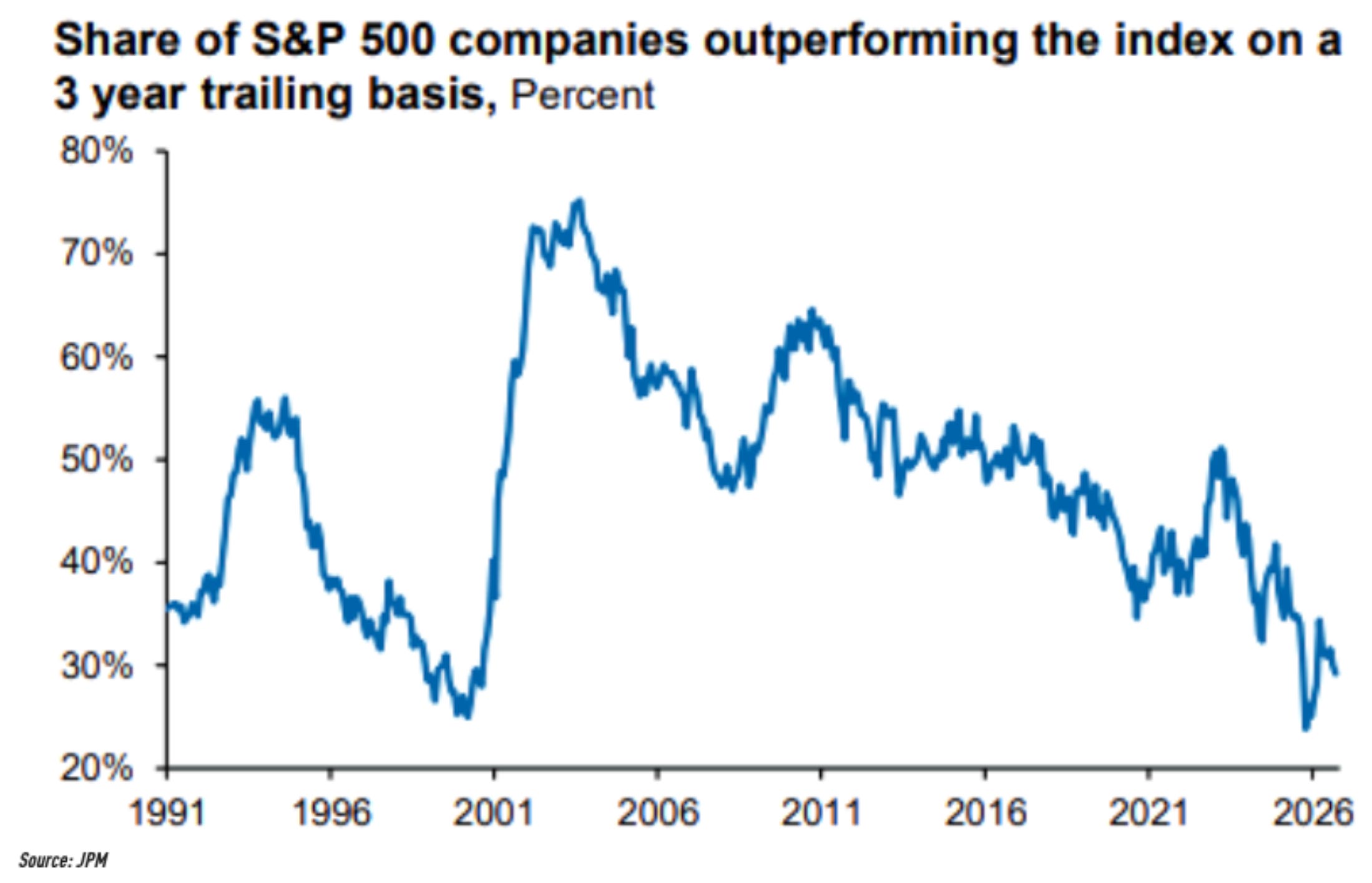
So think about what own a little of everything really means. You own the winners. You also own thousands of companies that contributed little or nothing to the market’s overall wealth.
The first investing book I ever read was Peter Lynch’s One Up on Wall Street. I’ve brought it up more times than I can count. Lynch had a word for this. Diworsification.
He coined it decades ago. The data has only gotten more on his side since.
The Delusion
Diversification does one job really well. It protects you from being wrong about any one company.
That’s exactly why index funds work. You don’t have to know which companies will win. You own them all.
But when you’re picking individual stocks, I don’t see the point in owning 20 or 30 names just to say you’re diversified. You’re doing the work of an active investor without getting the benefits.
And past a certain point, adding stocks doesn’t make you meaningfully safer. I had Claude help me run the numbers to see if that’s actually true. It is.
With 8 stocks, you already capture 83% of the reduction in volatility you’d get from owning all 105 stocks in this test. Going from 8 stocks to 20 barely moves the needle.
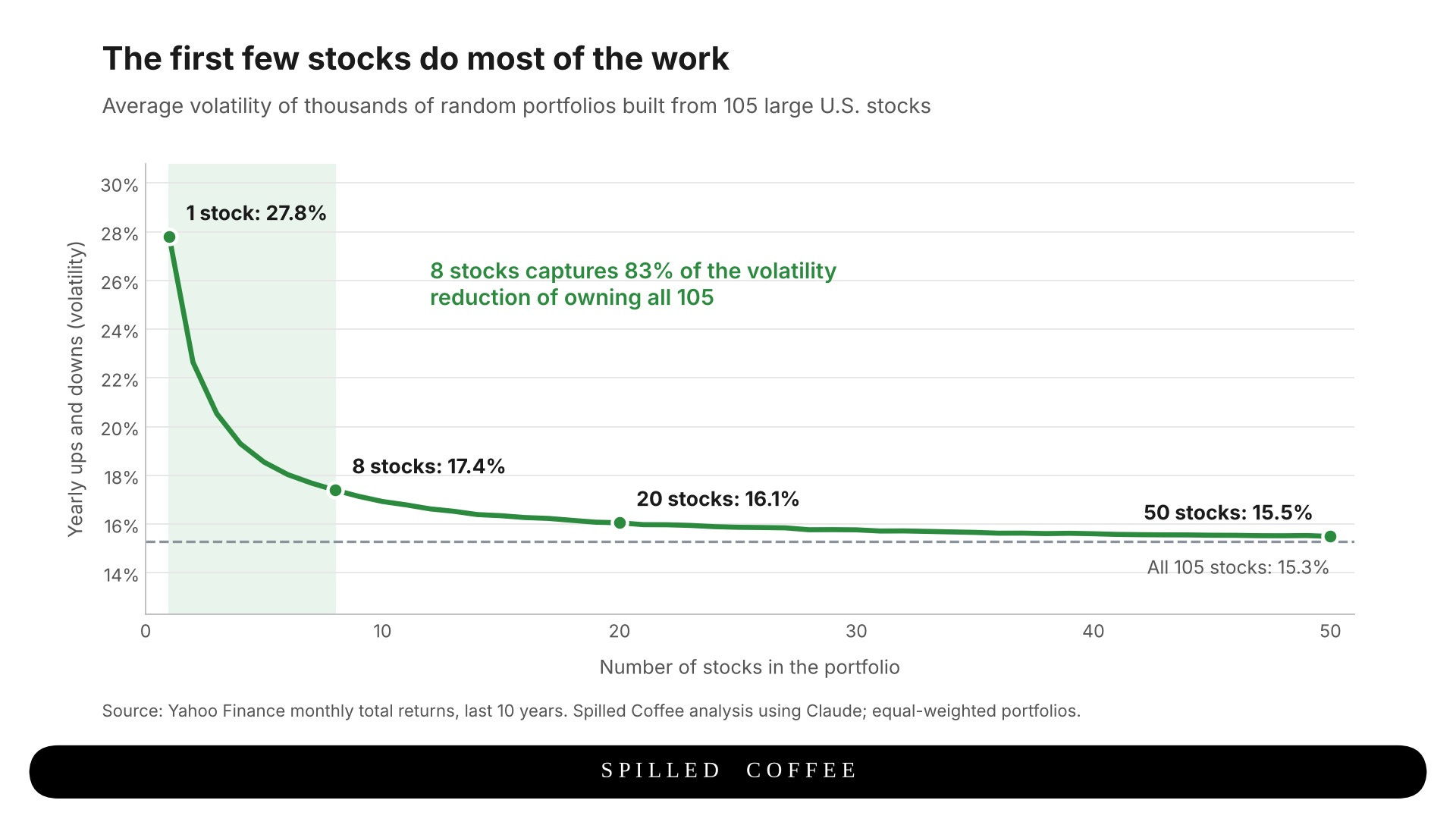
At some point you’re better off buying the index and spending your time elsewhere. That’s what I do with part of my money.
Ben Carlson made a great point on this recently in Most Stocks Are Losers, and I agree with him. This has been one of the hardest stretches ever for professional fund managers. A handful of stocks did almost all the work, and most stocks lagged. But it’s been a great time to be an individual investor willing to own the winners and hold them.
If you want to beat the market, you have to own the winners. And own enough of them for it to matter.
Of course, nobody knows which 3.7% will create the next century of wealth. That’s the hard part. I don’t need all 8 to become generational winners. I need businesses I understand, believe in, and think can compound for years.
That’s why I only own 8 stocks.
Why 8?
I didn’t start here.
Years ago, I owned 15 stocks. I thought that was concentrated.
Then I slowly cut back. To 12. Then 10. Not to prove a point. Every time I cut, I got better at knowing what I owned.
Today it’s 8. And I’ve learned I’m at my best with 10 or fewer.