
Let me be straight with you. I’ve been sitting here staring at headlines, charts, and newsletters about AI for weeks, and I keep arriving at the same uncomfortable conclusion: nobody knows what’s going to happen next. Not me. Not the Wall Street analysts. Not the venture capitalists pouring billions into data centers. Not the CEOs rushing to put “AI-powered” in their earnings calls.
Nobody knows.
And yet, the takes keep coming. The columns keep piling up. The newsletters keep landing in your inbox, each one more breathless than the last. Some will be bullish. Many, if not most, will be bearish and fear mongering, because here is the dirty little secret of financial media: fear sells. Fear gets the clicks. A headline that says “AI Could Be Just Fine” doesn’t move the needle. “THE 2028 GLOBAL INTELLIGENCE CRISIS” absolutely does.
Before we go any further, I want you to hold onto one idea as you read everything that comes out about AI, whether it is from me or anyone else in the weeks and months ahead: it is all a best guess. The most confident voice in the room is still guessing. The most bearish doom piece and the most bullish moonshot prediction are both working with incomplete information about something none of us have ever seen before.
That’s what makes this moment so disorienting. And so fascinating.
The AI Trade That Ate Itself
Not long ago, the playbook was simple. If a company mentioned AI in an earnings call, the stock went up. If an executive said “we’re integrating AI into our workflow,” investors cheered. AI was the golden ticket, and everyone wanted one.
That trade has gotten a lot more complicated.
Now, the very companies that rallied on the promise of using AI are being sold off as the AI developers come after their core businesses directly. Anthropic’s Claude releases new tools aimed at HR, financial analysis, equity research, private equity, wealth management, investment banking, and suddenly the stocks of companies in those industries sell off. The market is essentially pricing in a question it doesn’t know how to answer: if AI can do what these companies do, what are these companies worth?
Each release is a small tremor. And the market, fragile and anxious, shakes.
The reaction to Citrini Research’s recent piece on AI, what they’re calling a potential intelligence crisis, sent ripples through the financial world. Was Citrini too bearish? Maybe. But “too bearish” and “wrong” are different things. And the market’s violent reaction to it tells you something important: the anxiety is real, even if the specific predictions are uncertain.
Elon Said What Now?
In 2014, Elon Musk gave an interview and said something that sounded, at the time, like science fiction wrapped in paranoia:
“I think we should be very careful about artificial intelligence. If I had to guess at what our biggest existential threat is, it’s probably that. So we need to be very careful... With artificial intelligence, we are summoning the demon.”
People rolled their eyes. I still remember the day he said it because it stuck with me. At the time I thought, what on earth was he smoking?
It sounded less like something you would expect from the CEO of a car company and more like a late night dorm room debate after too much caffeine. Far fetched. Exaggerated. Almost absurd.
That was twelve years ago.
I’m not saying he was right. I’m not saying he was wrong. I’m saying that when I read that quote today in 2026, watching AI tools roll out across every industry simultaneously, I pause in a way I didn’t before. The gap between the idea and the reality has closed faster than almost anyone predicted. That’s worth sitting with.
The Industries Falling Like Dominos
Let’s walk through what’s already happened, because I think we underestimate how quickly things have moved.
AI came for software development first. Tools that could write and debug code faster than engineers. Then cybersecurity. Then it landed in HR, with AI agents that can handle recruiting, onboarding, and performance reviews. Now accounting and financial planning are squarely in the crosshairs.
Anthropic recently released a suite of new plugins covering HR, design, engineering, operations, financial analysis, investment banking, equity research, private equity, and wealth management.
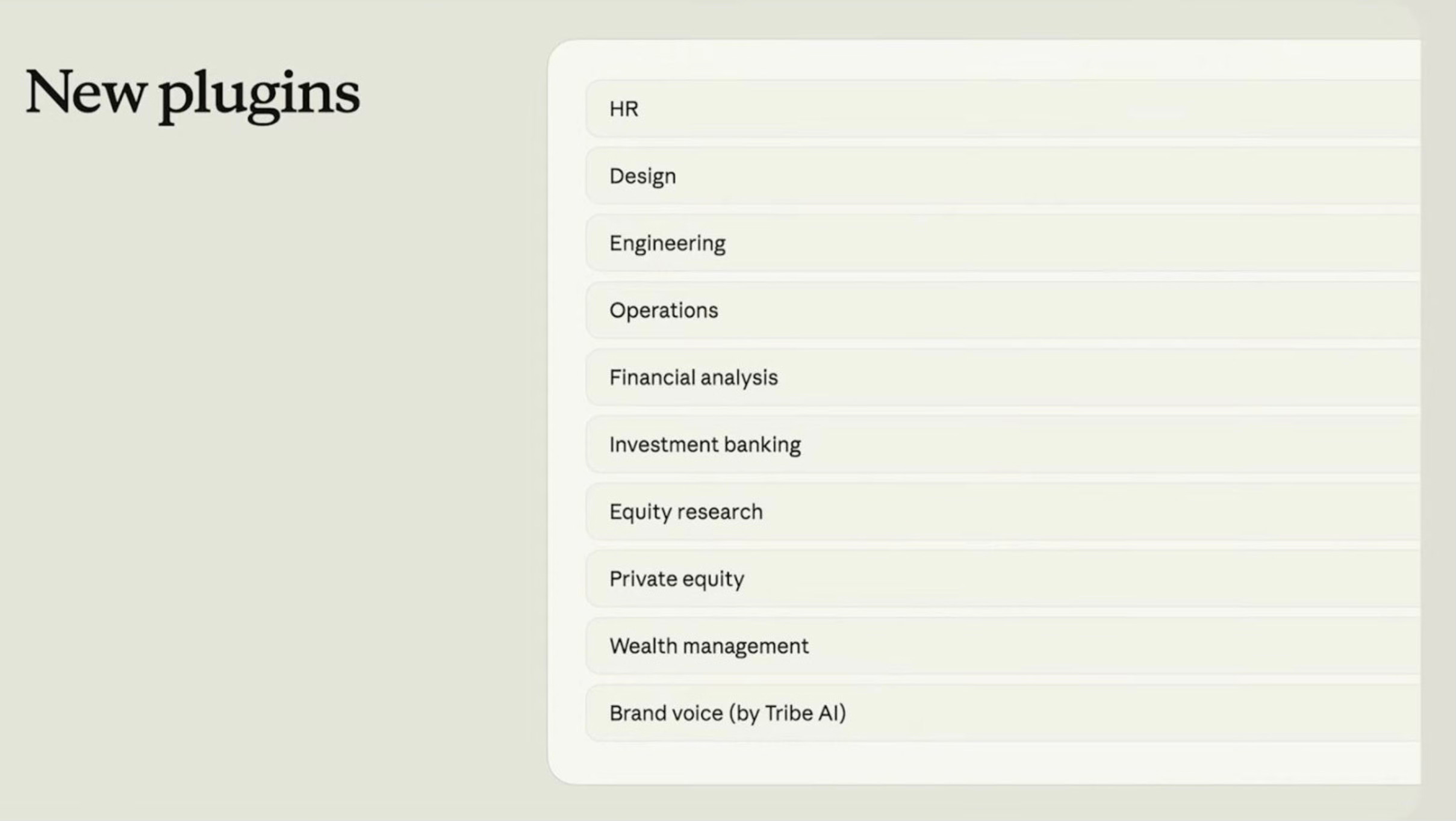
Essentially a roadmap of white-collar industries they’re moving into. Then came deeper integrations: admin controls, workflow automation, connectors built to work inside Microsoft Excel and PowerPoint.
Read that list again slowly. That’s not a niche. That’s a significant portion of what office workers in America do every day.
And this isn’t just a software story anymore.
The Layer Underneath the Layer
Here’s where it gets harder to think about.
When people try to reassure themselves about AI disruption, they often reach for the same comfort: “Sure, AI might take white-collar jobs, but trades and physical jobs are safe.” The plumber, the electrician, the nurse, AI can’t do those, right?
Maybe. For now.
Because the next layer of the AI onion, and I realize how uncomfortable this is, is humanoid robotics. AI-driven robots that can perform physical tasks. Companies like Figure, Boston Dynamics, and Tesla’s Optimus program aren’t building these machines for science fairs. They’re building them for warehouses, factories, and eventually homes.
Once you start thinking about that layer, it becomes genuinely hard to identify an industry that is fully insulated. Not just hard, nearly impossible.
Is your head spinning yet?
We’ve Been Here Before. Sort Of.
The optimist in me keeps reaching for historical context, because history offers the only honest comfort here.
We’ve done this before. Three times, actually.
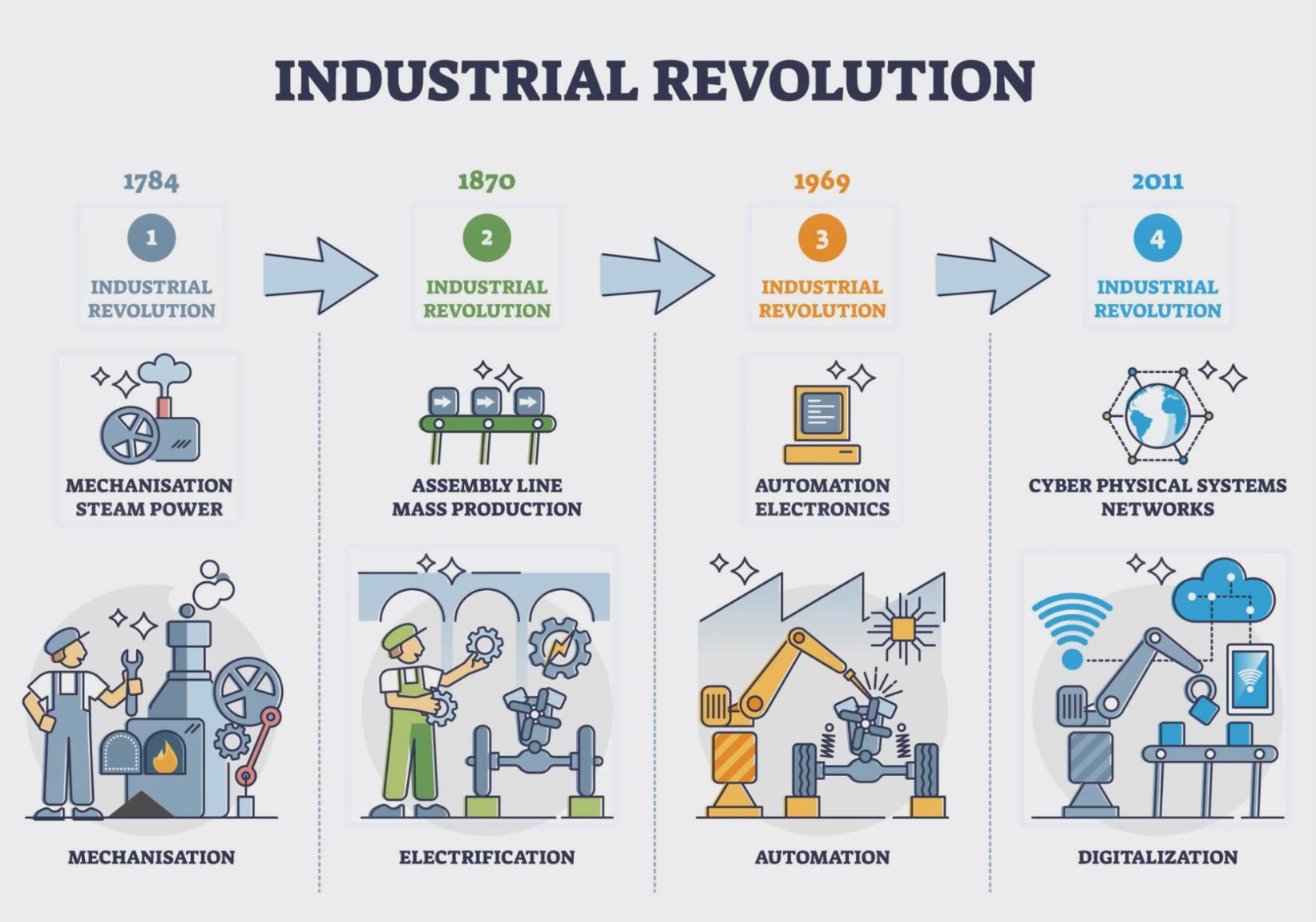
In 1784, the steam engine didn’t just change how goods were made. It rewired the entire economic order of the world. Millions of people who worked in ways that had sustained their families for generations found those ways obsolete within a generation. It was terrifying in real time. In retrospect, we call it the First Industrial Revolution and frame it as progress.
In 1870, mass production and assembly lines did it again. In 1969, automation and electronics again. Each revolution displaced workers, disrupted industries, and created enormous anxiety, and each one, in time, created more prosperity and more jobs than it destroyed.
Now we’re at the Fourth. The digital world merging with physical reality through AI and robotics. Cyber-physical systems that don’t just process information but act in the world.
The difference, the part that keeps me up at night, is the speed. The First Industrial Revolution played out over decades. Workers, institutions, and governments had time to adapt, however painfully. This one is moving in months. The plugins released last week will be obsolete in six months. The job that feels secure today is being evaluated right now by someone’s AI roadmap.
The internet changed everything too, we remind ourselves. And it did. But it also took twenty years to fully reshape the economy. This feels faster.
What Main Street Isn’t Ready For
Wall Street is anxious about valuations and disruption cycles. That’s its job.
Main Street is anxious about something more immediate: Will my job exist in three years?
The accountant at a mid-sized firm. The financial analyst at a regional bank. The HR manager coordinating hiring across a company. The equity researcher producing reports. These aren’t abstract roles. These are mortgages, kids in school, and retirement accounts. These are real people looking at a list of new AI capabilities and trying to figure out where they fit.
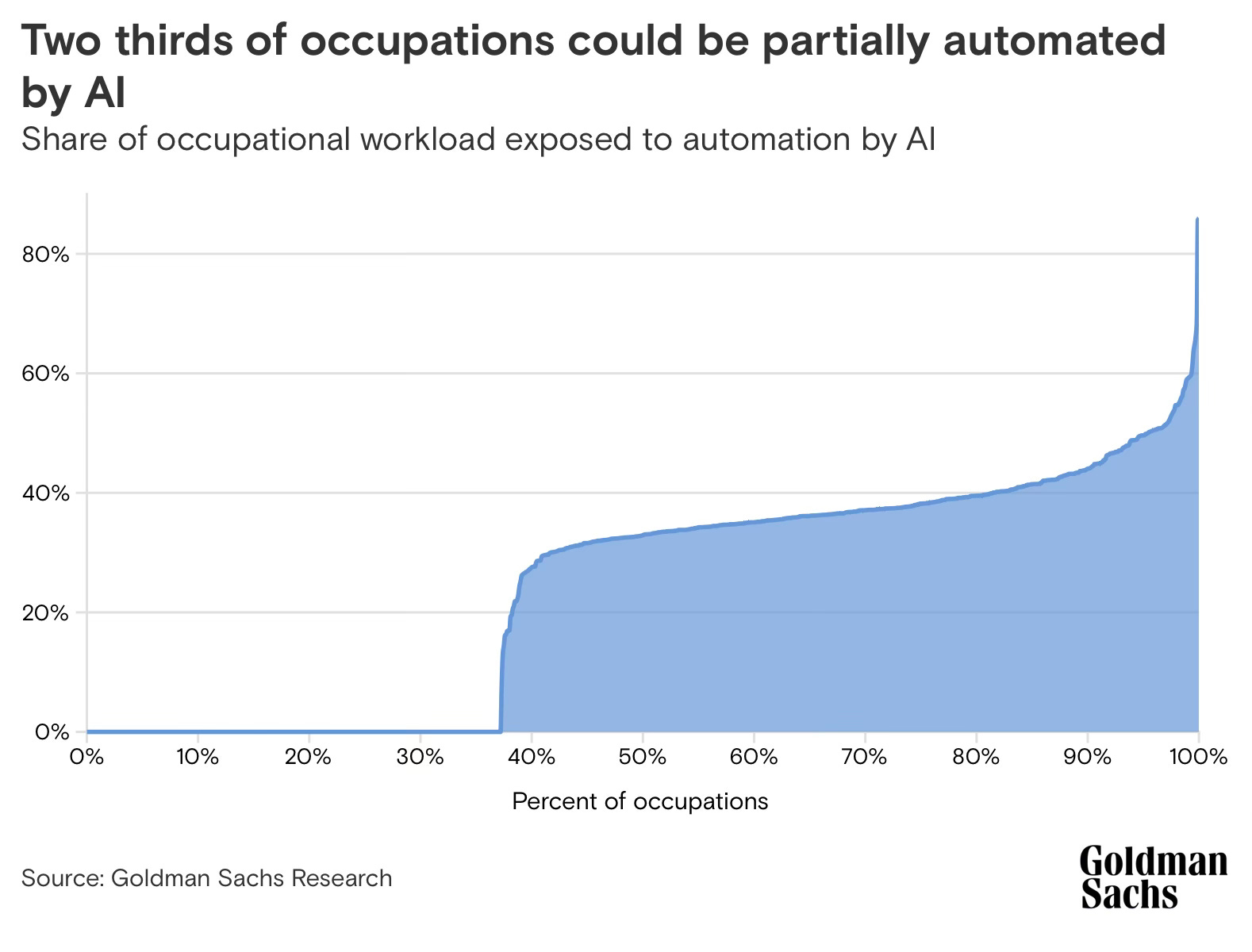
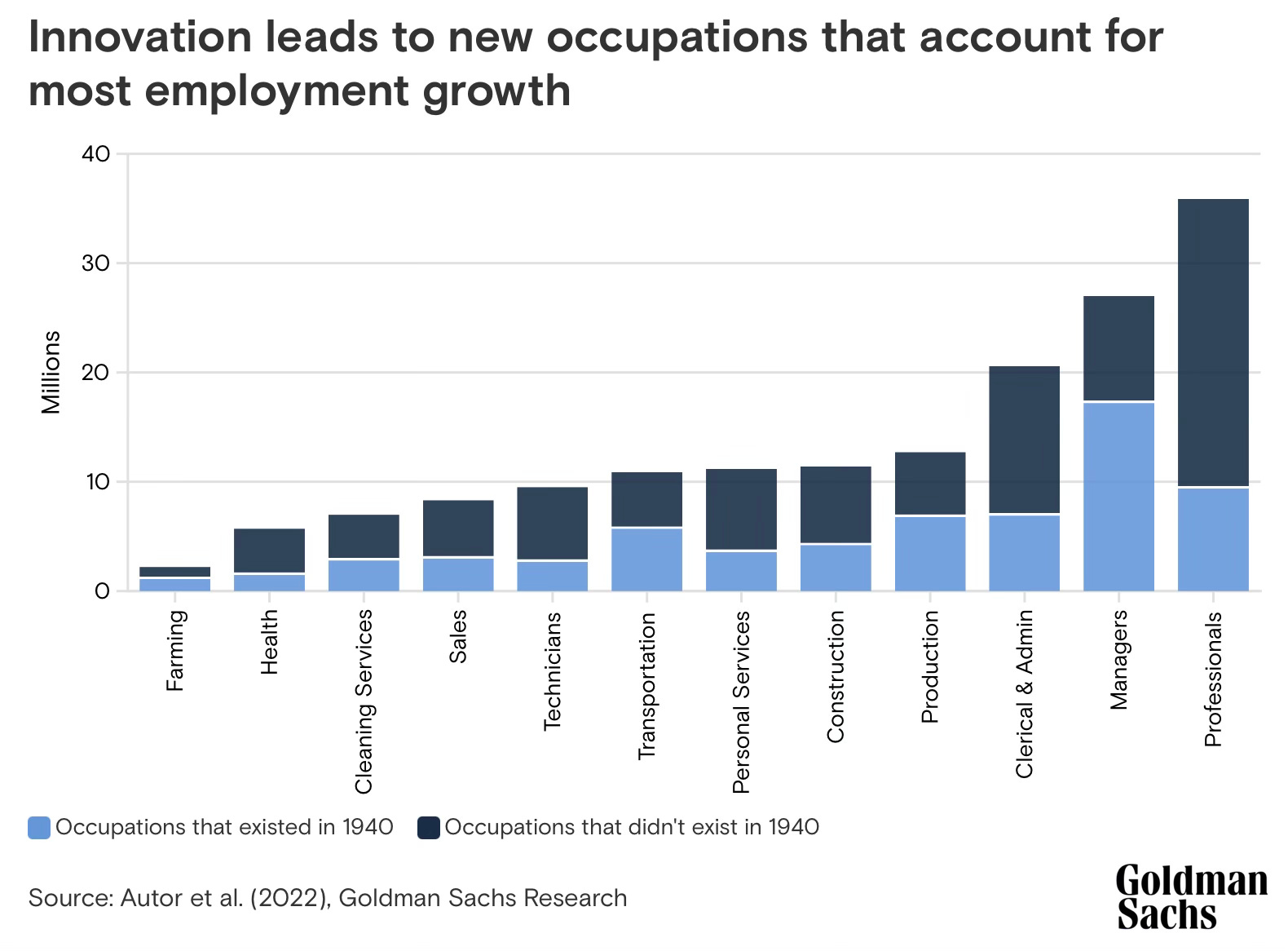
I don’t have a clean answer for them. No one does. The honest answer is: some of these jobs will evolve dramatically, some will shrink, and some will disappear. New jobs will be created that don’t exist yet. That’s the historical pattern. But “new jobs will be created” is cold comfort if you’re 47 years old and mid-career.
The real conversation should be about retraining, how we help people transition, who pays for it, and which institutions step up to support it. That is the discussion we are not having loudly enough. We’re too busy arguing about whether AI is good or bad, bullish or bearish, demon or savior.
Two Reads Worth Your Time
If you want to dive deeper into the competing visions of where this goes, two pieces have generated enormous discussion:
Matt Shumer’s Something Big Is Happening captures the vertigo of the moment from an optimistic, awe-struck perspective — the sense that we’re watching something genuinely historic unfold in real time.
Citrini Research’s The 2028 Global Intelligence Crisis takes the darker view, arguing that the displacement will come faster and harder than markets and institutions are prepared to handle.
Read both. Hold both. Neither is certainly right. That’s the point.
So Where Does That Leave Us?
I could end this with a confident take. Readers respond to confident takes. But I’d be lying.
Maybe AI doesn’t end the world. Maybe it doesn’t even end most jobs. Maybe it’s the most significant technological advancement in human history. The next internet, or bigger and we’re watching the early, awkward, terrifying phase before the transformation settles into something extraordinary.
Maybe the Citrini piece is closer to right and the disruption comes faster and harder than any institution is equipped to handle.
Maybe it’s somewhere in between, messy and uneven and full of both loss and possibility in ways we can’t fully see from here.
What I know is this: more scary pieces are coming. They will get scarier. That’s not cynicism, that’s pattern recognition. Fear is the dominant narrative in uncertain times, and these are deeply uncertain times. When those pieces land, read them. Take them seriously. Just don’t mistake a compelling argument for a prediction.
The future isn’t written yet. Not by the bulls, not by the bears, not by the AI developers, and not by me.
My head is spinning.
I suspect yours is too.
And I don’t think it’s going to stop anytime soon.
Thank you for reading! If you enjoyed Spilled Coffee, please subscribe.
Spilled Coffee grows through word of mouth. Please consider sharing this post with someone who might appreciate it.