
I have a confession.
I don’t Google things anymore.
When I want to know something, I open ChatGPT. Or Claude. For twenty years Google was a verb. Now it’s a habit I’m slowly breaking.
I doubt I’m alone.
That got me thinking about another company that won its market, then found out winning wasn’t the finish line.
Netflix.
Netflix Won. Then What?
Netflix built streaming. Taught us to binge. Turned Blockbuster into a punchline.
It won.
And it’s still a terrific business. Last quarter Netflix did $12.9 billion in revenue and $3.66 billion in profit. Revenue up 12%. Profit up 44%.
But look at the stock. As of the November 6 close, it was down 32% this year and 53% from its peak. After that strong October report, it fell almost 6% after hours because the outlook disappointed.
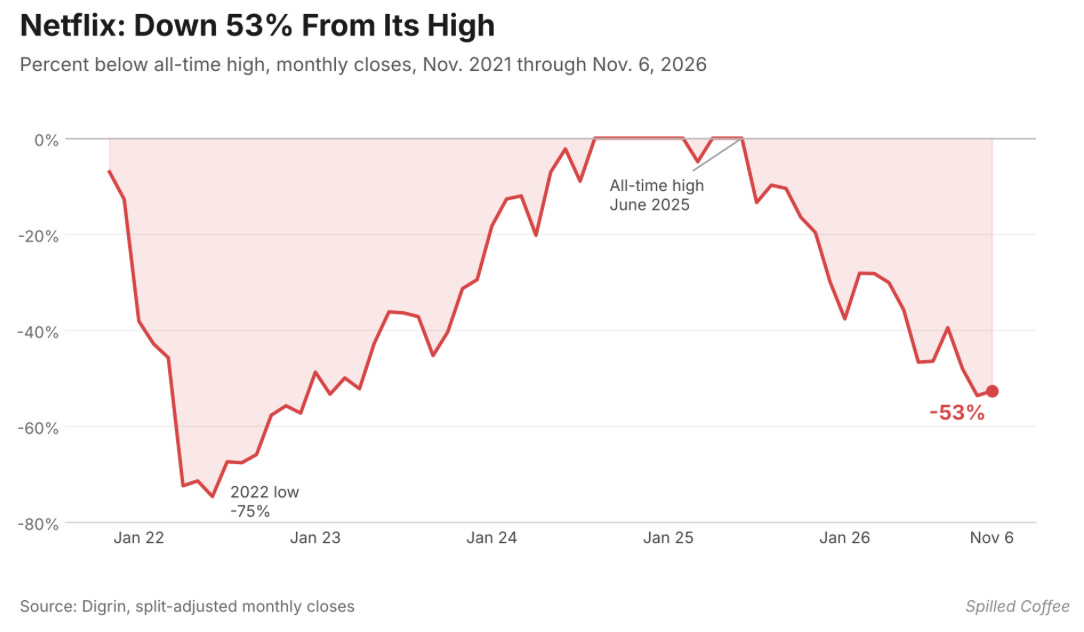
Those aren’t the numbers of a broken company. Viewing hours even hit a record 97 billion in the first half. They just grew 2%.
Then in October, Netflix cut about 6% of its workforce. Roughly 1,000 jobs, believed to be the biggest layoff in its history. Its chief content officer left, and former Disney TV boss Peter Rice took over. Investors aren’t paying for what Netflix already won. They want to know what comes next.
Here’s the part I keep coming back to. Netflix has to spend billions on content every single year just to hold its spot. Stop spending and people leave.
Winning came with a treadmill.
The Company Eating Netflix’s Lunch
Netflix’s biggest threat isn’t Disney. It isn’t HBO or Amazon.
It’s YouTube.
Think about the two models. One has to finance its content pipeline. The other has millions of creators doing much of that work for it.
YouTube did $11.2 billion in ad revenue last quarter, up 9%. YouTube Music and Premium just passed 150 million subscribers, including trials.
And who owns YouTube?
Google.
There’s an irony here. YouTube didn’t beat Netflix at its own game. It changed the game. Now Google faces its own version of that.
Which brings us to the real question.
Google Won Search
Google Search might be the greatest business ever built.
The flywheel was simple. Everyone went to Google. So advertisers had to be there. More users made the ads more valuable, which paid for a better product, which brought more users. For most people there was no real alternative.
That was the golden goose. Search still brought in $63.4 billion last quarter, roughly half of everything Alphabet makes.
And Google hasn’t lost it. Not yet. StatCounter has Google at about 91% of worldwide search in October, and around 85% in the US. Not the 95% days. Still overwhelmingly dominant.
I’ll be honest with you. My “I don’t Google anymore” habit is early. By StatCounter’s count, ChatGPT sends a fraction of a percent of the web traffic Google does.
But here’s the catch. That number only counts search engines. It doesn’t count the questions that never become a search at all.
Google can keep 90% of search and still lose a meaningful share of the questions people used to ask it.
And last quarter, for the first time, the numbers hinted at it.
More Searches, Same Money
Here’s the number that jumped out at me.
Sundar Pichai said search query growth last quarter was the fastest in five years. AI Overviews and AI Mode are working.
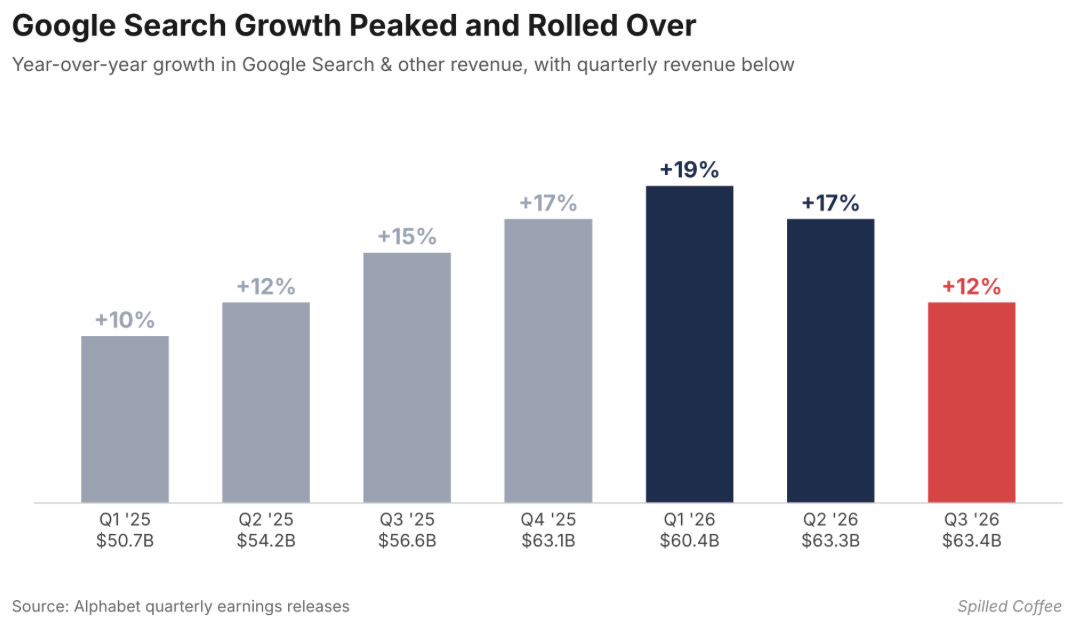
Search revenue grew 12%. Still solid. But look at the trend. 19% in Q1. 17% in Q2. 12% in Q3.
Now look at it quarter over quarter. Search revenue went from $63.27 billion in Q2 to $63.35 billion in Q3.
That’s a $79 million increase. On a $63 billion business. Basically flat.
Record searches. Same money.
To be fair, there’s noise in there. Google said currency was the single biggest reason for the slowdown, followed by softer retail and media ad spending. One quarter isn’t a trend, and a flat quarter on its own proves nothing.
But then Google’s chief business officer, Philipp Schindler, added one more reason on the call. Strong growth in AI Mode queries weighed on revenue, because AI Mode monetizes at a lower rate.
Read that again. Google said it out loud. More searches. Some of them worth less.
He listed it last, and Google didn’t say how much it cost. But think about it like an analyst. Currency will swing back. Retail spending will come back. AI Mode is the one factor that gets bigger every quarter, because Google is pushing it. Google is now taking AI Mode ads international and testing ads inside multi-turn conversations. Can those ads earn what ten blue links did? That’s the whole question.
There’s another way to look at this. Pichai compared it to the shift to mobile. Build the best experience first, monetize second. That’s probably the right call. If people love AI Mode, they stay inside Google.
But it means accepting less revenue today for the chance at a bigger business tomorrow. That’s a bet. And investors are being asked to pay for it.
Google’s Treadmill
Remember Netflix’s treadmill? Spend billions on content or lose your spot.
Google has one now too. It’s called capex.
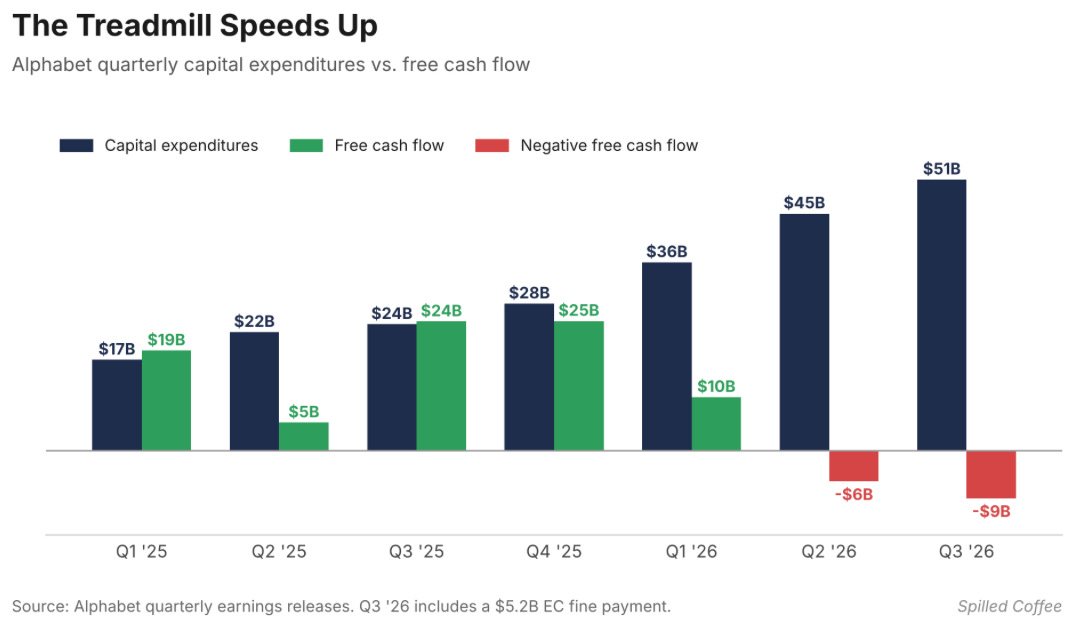
To make sure AI doesn’t eat Search, Google is building AI. A lot of it. Alphabet spent $51.4 billion on capital expenditures in Q3 alone. Full-year guidance is $195 to $205 billion. And management said 2027 will be significantly higher.
That spending flipped free cash flow negative. Minus $9.1 billion for the quarter. The second negative quarter in a row.
In fairness, two unusual items made it worse. A $5.2 billion European Commission fine, finally paid after appeals. And what I estimate was about $3 billion of inventory built up ahead of TPU chip sales. Back those out and, by my math, operating cash roughly covered capex.
Roughly. For a company that used to throw off cash like nobody else.
The market noticed. On October 29, Alphabet fell nearly 13%. Its worst day since going public in 2004. About $482 billion in market value gone in one session, the second-biggest one-day loss for any US company ever.
And this was on a quarter where revenue grew 25% and operating income grew 30%.
That tells you what the market is really worried about. Not that Google is shrinking. That defending the castle might cost more than the castle is worth.
That’s the Netflix problem. Winning stopped being free.
Google Has Been Here Before
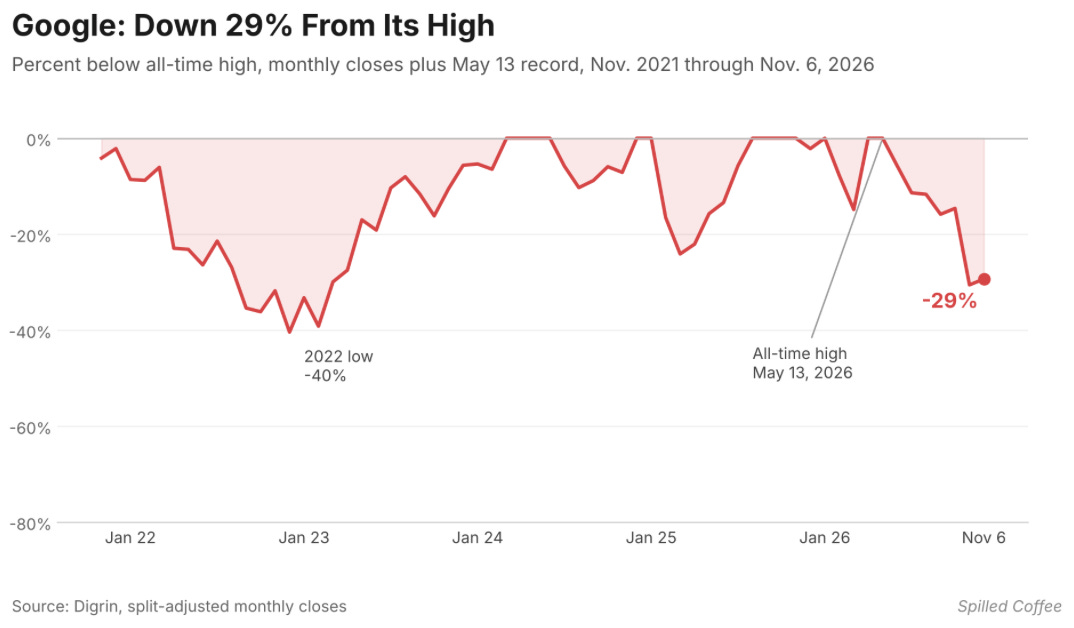
As of the November 6 close, Google was 29% off its May high.
Netflix is 53% off. So Google isn’t on the Netflix path. But the market has started pricing in the possibility.
Different companies. Different problems. Same question.
Now here’s the other side. Google has been here before. In 2022 it fell close to 40%. It took another big hit in 2025. Every single time, it came back to new highs.
And this is where Google really isn’t Netflix.
Netflix is one business. Google is five.
Cloud grew 103% last quarter to $30.7 billion. Google Cloud is now about a quarter of Alphabet’s revenue, with a $561 billion backlog. A little over half of that is expected to show up as revenue within two years.
Gemini just hit one billion users. Pichai called it the fastest-growing product in Google’s history. If search moves into a chatbot, there’s a decent chance the chatbot is Google’s.
YouTube is winning the very fight Netflix is losing.
TPUs, Google’s own AI chips, are starting to sell to outside customers, with management expecting a meaningful revenue ramp in 2027.
Waymo is still a long-term wildcard.
So here’s how I’d frame it. Google could win the AI race and still lose the economics of search.
Both things can be true.
My guess is the Google of 2030 looks less like a search company and more like a cloud and entertainment company that also happens to own Search.
You can already see it happening. Search is still growing, but Cloud is growing so much faster that Search has dropped below half of Alphabet’s revenue. Cloud is now about a quarter.
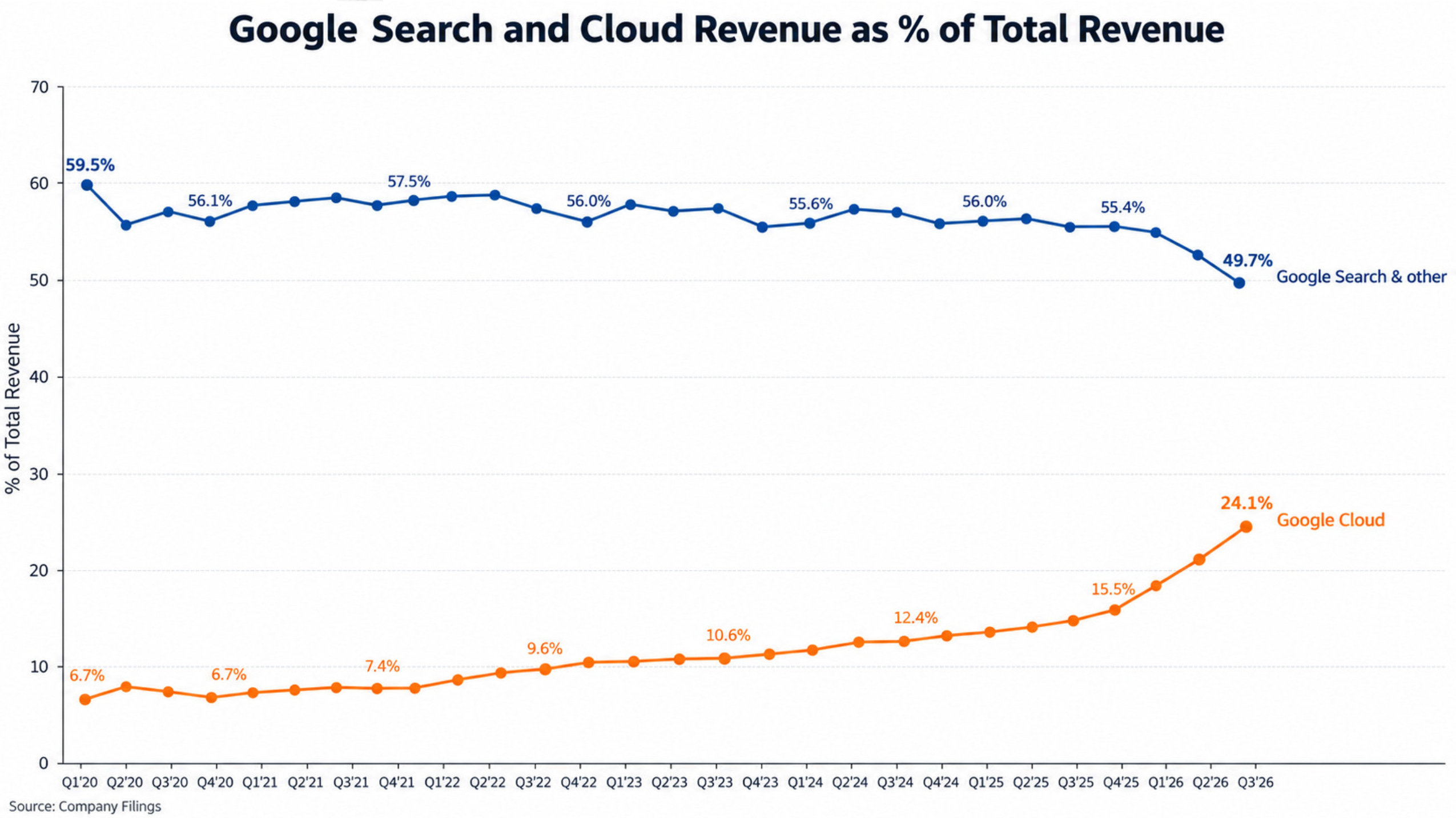
The question for investors is what that company is worth. Because it probably isn’t valued like the old monopoly. The market is already doing that math. Netflix went from about 28 times forward earnings in May to about 19 by late July. Google now trades around 19 times forward earnings, near the low end of its range over the past decade. The businesses are very different. But the market is asking a similar question. How much should investors pay for growth that may not look the way they expected?
What Would Make Me Worry
One slow quarter doesn’t make Google the next Netflix. Here’s what would.
Search revenue actually shrinks. Not slower growth. A year-over-year decline. That’s the golden goose stopping.
AI answers don’t turn into ad dollars. If Gemini and AI Mode keep growing but monetize worse than ten blue links, Google is trading a great business for a good one.
The treadmill speeds up. Capex keeps climbing in 2027 while Cloud growth cools. That’s Netflix’s content problem with a bigger price tag.
US share keeps sliding. Watch that 85%. If it’s 80% a year from now, something real is happening.
None of those has happened yet. But for the first time, I can see a path to each of them.
One disclosure. I sold my Google position last year, and the stock is still well above where I sold, even after this drop. So I’m not writing this to feel better about a sale. I still think Google has an enormous opportunity in AI, Cloud, and YouTube. But I wanted to understand what happens if the economics of its most important business start to change. That’s what this piece is really about.
Google won search.
Now it has to figure out what winning looks like when people stop searching.
Thank you for reading! If you enjoyed Spilled Coffee, please subscribe.
Spilled Coffee grows through word of mouth. Please consider sharing this post with someone who might appreciate it.