
There is no script.
Everyone thinks that they know what happens next. Sports and investing are the same game that way. Nobody knows. That’s why we watch. That’s why we invest.
Eventually this bull market will end. I don't know when. You don't know when either. Nobody does. That's the point.
I’m a known bull. You know that about me by now. So take the next thousand words with whatever grain of salt that you want to take them with. But I didn’t get here on vibes.
I’m not asking you to trust my gut.
I’m asking you to trust my math.
The S&P 500 closed today at 7,509.
10,000 isn’t a headline I’m writing for clicks. It’s arithmetic. Let’s do it together.
The Gap Isn’t What You Think
From 7,509 to 10,000 is a move of 33.2%
Round numbers get treated like some distant mountain peak. Far off. Foggy. Maybe not even real. It's not. It's a percentage. So let's run it like one.
At 8% a year, roughly the market’s long run average before dividends, you’re there in about 3.7 years
At 10% a year, you’re there in right around 3 years
At 12% a year, a good stretch but nothing we haven’t seen plenty of times, you’re there in about 2.5 years
That's a few years from now number, not a someday, maybe number. This is the part that gets lost every time a round number shows up in a headline. Nobody does the actual math. They just react to the zeros.
Or It Could Happen Faster Than You Think
Here’s the part that made me want to write this today instead of waiting.
The 8 to 12% math above assumes something close to average. But the S&P hasn't exactly been average lately.
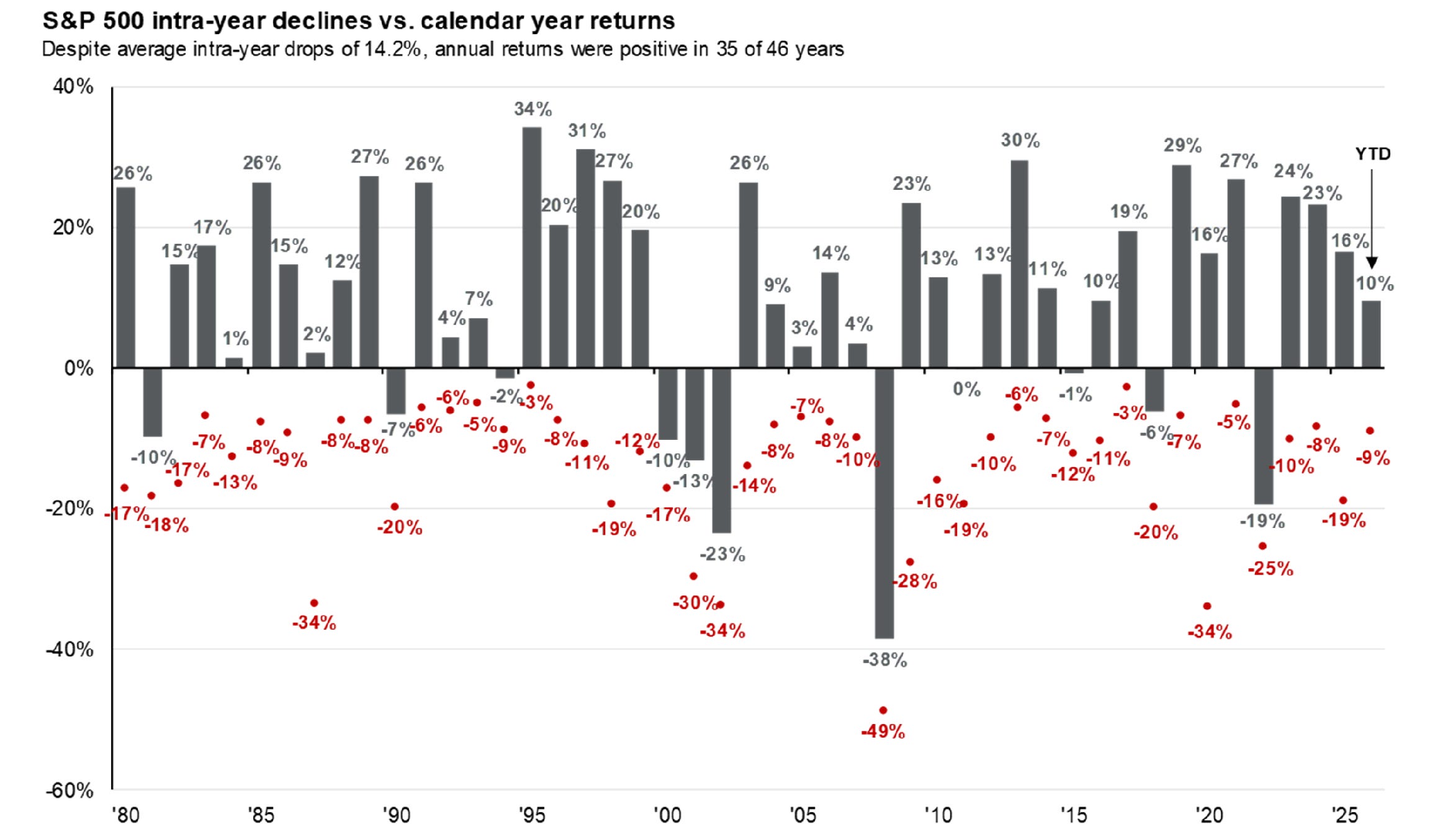
Look at the last nine calendar years. Five of them, 2017, 2019, 2021, 2023, and 2024, closed with the index up more than 20%. That's better than half. Big up years haven't been some rare event you tell your grandkids about. They've basically been the house odds of late.
Run that forward instead of the long run average. Stack two years like 2023 and 2024 back to back, up 24.2% and 23.3%, and you're compounding to a 53% gain in two years. From 7,509, that clears 10,000 with room to spare. Get just one year like 2023 alone and you're sitting around 9,324, needing another 7% to finish the job, which could show up in a matter of months if the tape cooperates.
So the honest range isn’t 3 to 4 years. It’s as soon as 12 to 18 months if we get another year or two like the ones we just had, and probably no more than 4 years even if things slow back down to average.
Yes, there were bad years mixed in there too. 2018 was down. 2022 was ugly. That’s the deal. Nobody hands you the good years without the bad ones attached. It’s the price of investing.
But the person who sold in 2018 or 2022 missed every single one of the big years that came right after. That’s the actual lesson in that table, not the up years or the down years in isolation, it’s that you have to stay in the market.
We’ve Done This Dance Before
People act like round numbers are rare. They’re not. They just get closer together in percentage terms as the index gets bigger, even though the dollar gap looks scarier.
Here’s the actual history, not the vibes version.
The S&P first closed above 1,000 on February 2, 1998. It took until August 26, 2014 to close above 2,000. Sixteen and a half years for that one.
Then it started moving. 3,000 came July 12, 2019, under five years later. 4,000 came April 1, 2021, under two years after that.
Then it really started moving. 5,000 hit February 9, 2024. 6,000 hit November 11, 2024, about nine months after that. 7,000 hit in the spring of 2026, roughly a year and a half later.
1,000 to 2,000 = +100%
6,000 to 7,000 = +16.7%
Same headline. Completely different amount of work.
That’s the trick round numbers play on people, and it’s why 10,000 sounds so much scarier than up 33% from here, even though they’re the exact same thing.
This isn't a forecast. It's a probability exercise. The path won't be straight, and nobody knows the timeline. The point is simply that 10,000 requires far less than most investors assume.
What Would Actually Have To Go Wrong
I’m not going to sit here and pretend there’s no case against this. There’s always a case against this. That’s the whole first line of this post.
Plenty could slow this down. Sticky inflation. Higher rates. AI spending disappoints. Recession. Valuations compress. Those are all real risks.
I’m not brushing any of that off. It’s all real. It’s all worth thinking about.
But none of it kills the math above. It just changes which line you land on. Even the slow, higher for longer, multiple compression path still gets you to 10,000 in well under a decade at a mediocre growth rate. The honest bear case here isn't that we never get there. It's that it takes longer than the fast case.
And that path, even the fast one, was never going to be a straight line. Remember that chart above. The S&P has averaged an intra-year drop of 14.2% going back to 1980, and it still finished positive in 35 of the last 46 years. That’s 76% of the time.
The people who miss the big years aren’t the ones who guessed wrong about the economy. They’re the ones who got off the roller coaster during one of those normal, average, 14% dips and never got back on before it turned green again.
The One Thing I’d Tell You
Stop asking whether 10,000 is realistic. It is. The math says so. The history says so.
Start asking yourself a different question instead.
Are you actually going to be in the market when it happens?
Or are you going to be the person who spent years waiting for the perfect entry? Or worse, the person who finally got shaken out during a perfectly normal dip, right before the recovery.
The market gives you reasons to sell every single year. It also finishes green in 3 out of every 4 of them anyway.
Play your own game. Buy your stocks. Let the math do what it’s done every single time before.
10,000 isn’t a prediction. It’s what happens if you just stay in the game long enough.
The only question is whether you’ll still be playing it.
Thank you for reading! If you enjoyed Spilled Coffee, please subscribe.
Spilled Coffee grows through word of mouth. Please consider sharing this post with someone who might appreciate it.